 By Rafael CardosoOctober 17, 20267 min read
The Floor: A Control Room for the Tournament Director
Until now, the screen you ran a tournament from was the one the players were watching: the clock. The pause button sat on the TV next to the blinds, every player menu opened in front of the whole room, and the things a director needs between hands were spread over four tabs.
The Floor is the director's screen. The clock stays what it should be, the room's display. The Floor is where you run the room from, on a laptop, an iPad or your phone. It sits right under Clock in the sidebar of every live tournament and cash game, for the club's owner and admins (and a cash session's own game admins), and it goes away once the game is over, because there is no room left to run.
One screen, in the same place every night
The layout is fixed on purpose. There are no widgets to drag around: you learn where everything is once and find it in the same place every week.
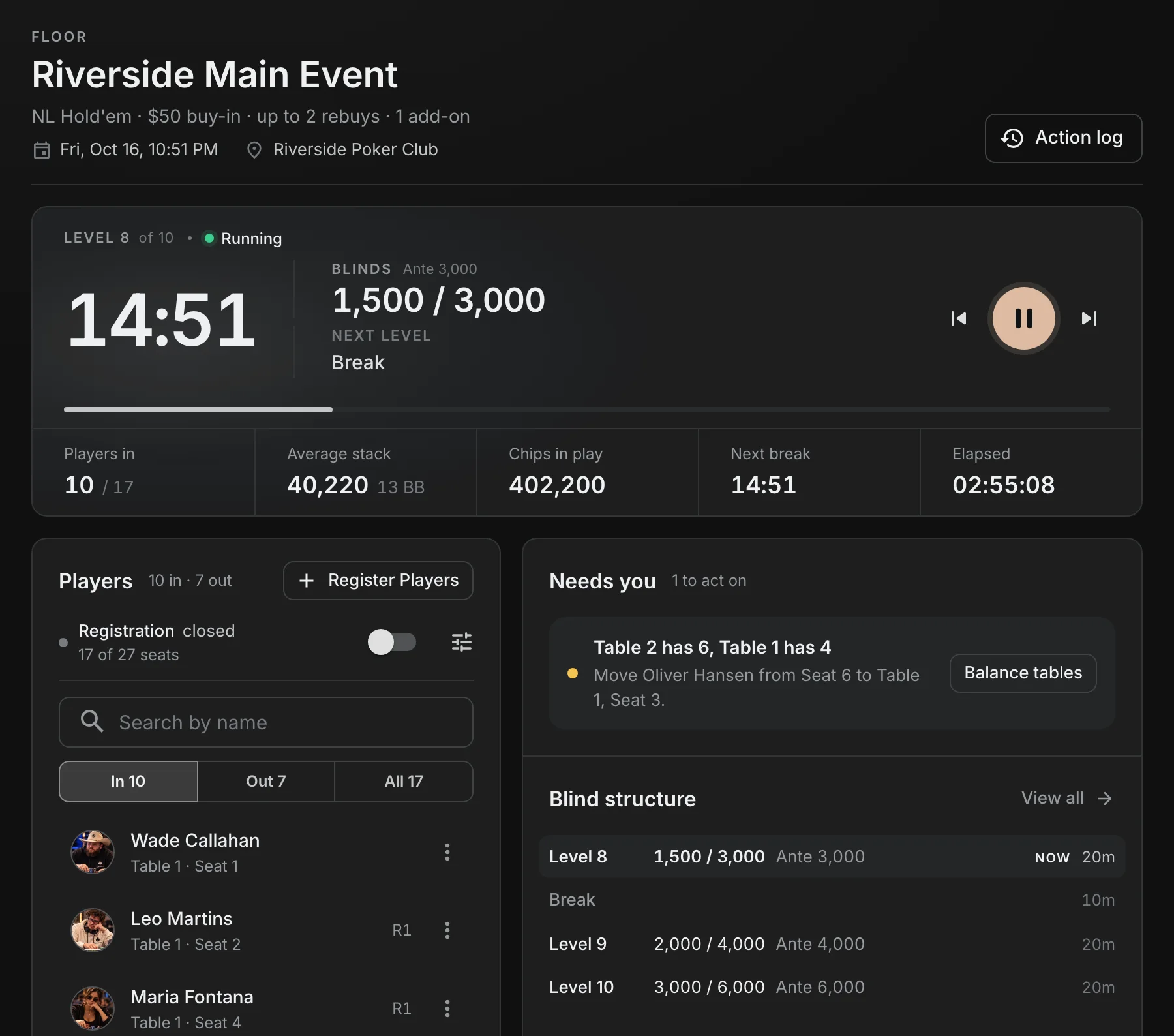
The heading is the game itself: what is being played, the buy-in, when and where. The name and the location edit right where they stand.
The clock, as the director drives it
One line holds the time, the blinds and ante, what comes next, and the controls: pause or play, a level back, a level forward. The line under it is the level's progress, and you can drag it to set the time. Under that are the numbers I check between hands: players in out of entries, the average stack in big blinds, chips in play, time to the next break and how long we have been playing.
Every press is the same one the clock page makes, so every screen in the room moves together. A mixed game that changes game every orbit gets a Next game button beside the level controls. Scroll down and a compact clock follows you under the heading.
The roster: find a player, tap, act
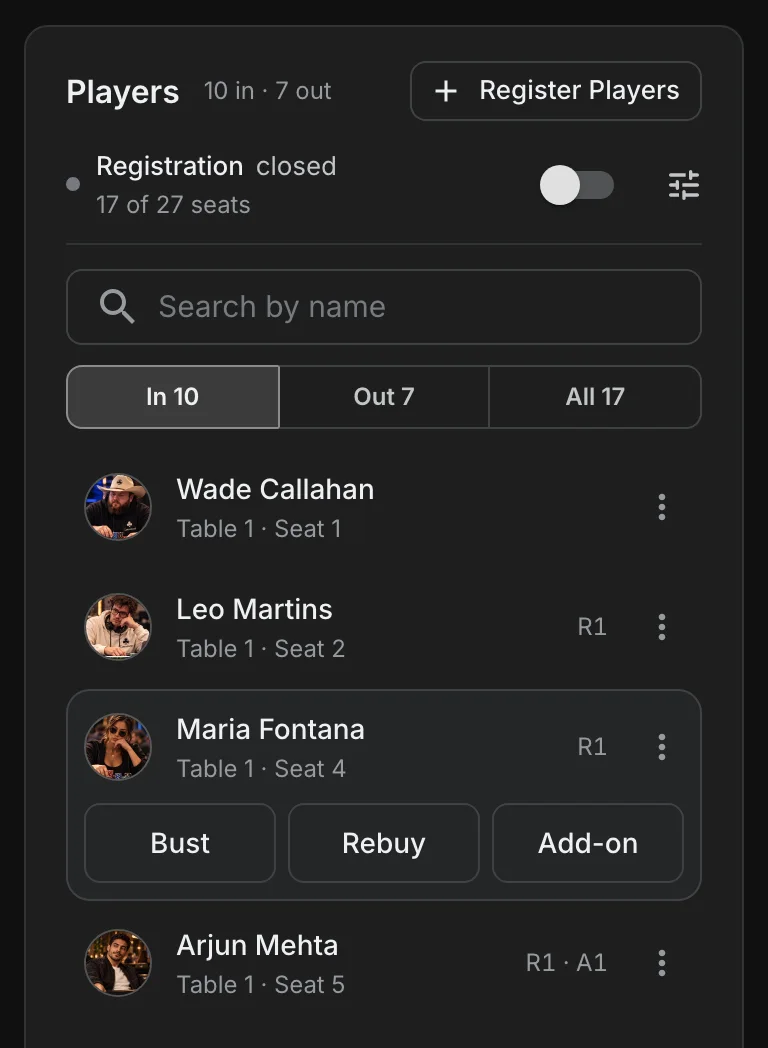
The roster lists who is still in by table and seat, with their rebuys and add-ons as small tags. Tap a name and the things you do most open right under it: Bust, Rebuy and Add-on. Rebuy and add-on only show when the tournament allows them, and they grey out once the player has used their limit. A player who is out gets Undo bust instead, and in a re-entry tournament Re-enter while registration is open. Bust opens the same elimination dialog as everywhere else, so you can still say who knocked them out.
Above the list is registration: open or closed, when it closes next (after a level, or at a time), how many seats are taken, and a switch to change it now. If your tournament requires check-in, the roster gets a Waiting filter, and a player who registered but has not arrived shows Check in instead of Bust, because they are not in the game until they are here.
Needs you
The Floor works out what the room needs next from the state of the game, and lists it with the button that does it:
- Tables out of balance, with the exact move: who, from which seat, to which table and seat. Balance tables opens the balancing plan to review before anything moves.
- Players without a seat, or no tables drawn yet, with a way to the seating page.
- The final table, or a table that can break, as soon as the players left fit at fewer tables.
- Players registered but not checked in, with Check in all.
- Registration closing after a given level, heads-up, and a clock that has not started yet.
When there is nothing to do, it says so: "Nothing needs you right now."
The rest of the board
Blind structure
The levels around the one in play, breaks included, with a link to the full structure.
Prize pool
The pool, the entries, rebuys and add-ons behind it, and what each paid place gets.
Tables
The five tables that changed last, seat by seat, and whether the room is balanced.
Displays
The screens showing the tournament, online or offline, and a way to connect another. Pairing a screen needs TV sharing, which is Premium.
On a wide desktop (1400 pixels and up, so a 14 inch MacBook) the roster becomes a rail down the right edge, as tall as the window, with the tables under it. On a laptop or an iPad it is a card on the left with the board beside it.
The action log, and a way back from every mistake
Every director has busted the wrong player at some point. Until now, fixing it meant remembering what the right state was and rebuilding it by hand while the room waited.
The Action log button in the Floor's heading opens the log beside the board: every registration, bust, rebuy, add-on, seat move, payout change and level, newest first, with who did it.
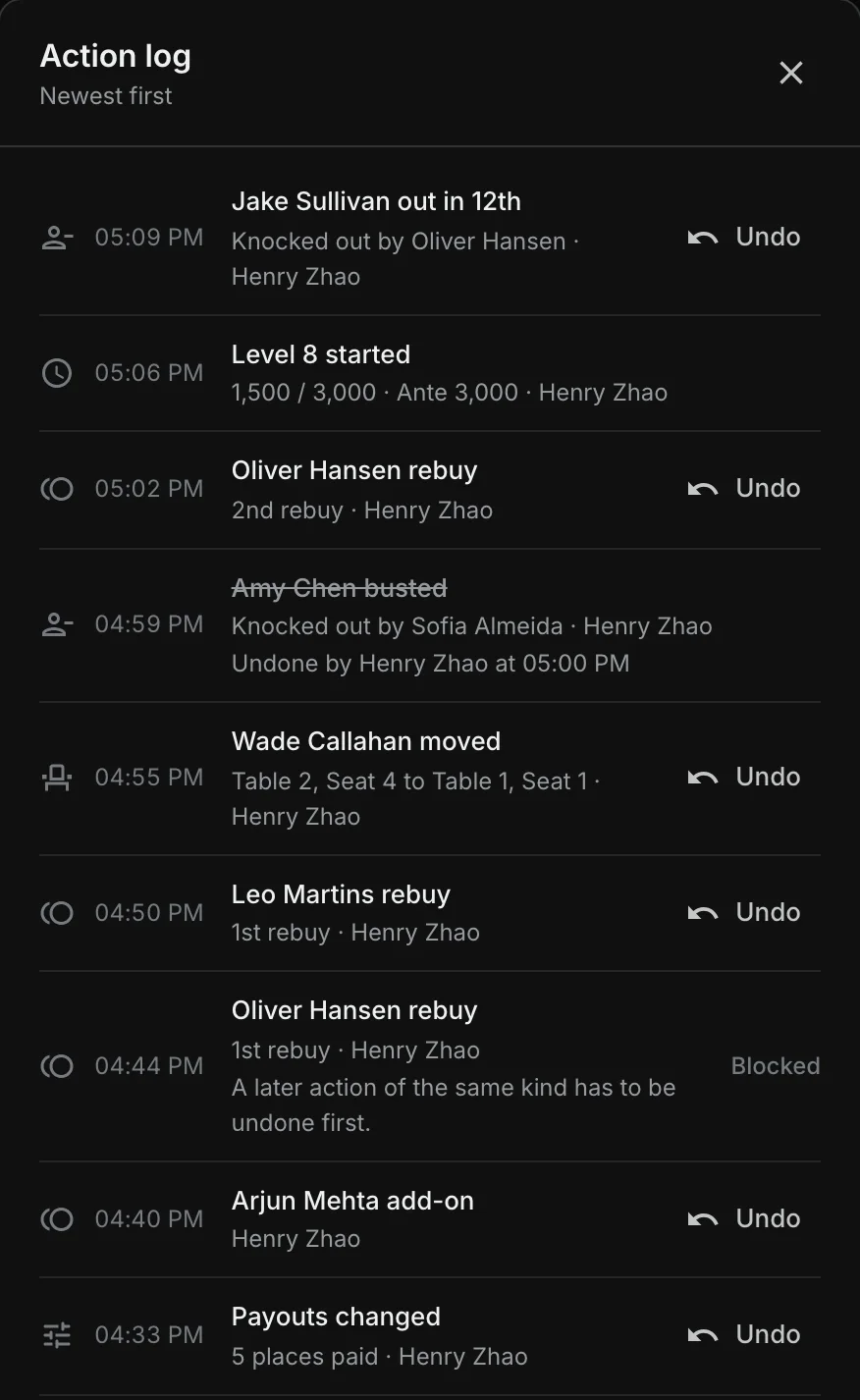
The Undo sits on the row it reverses, so you fix the mistake where you see it. What each one does:
- Undoing a bust puts the player back in their seat (or the first free one, if someone has taken it) and clears the knockout and any bounty. Prizes are worked out again.
- Undoing a registration asks first, and is only offered while the player has not played yet.
- Undoing an unregistration brings the player back, in their old seat if it is still free.
- Rebuys, add-ons, seat moves and payout changes go back one step at a time, newest first.
When an entry cannot be undone yet, the row says why instead of offering a button that would fail: a later rebuy has to come off first, the player has been knocked out since, they have moved since, or someone is sitting in the old seat. An undone entry stays in the log, struck through, with who undid it and when.
Two limits are deliberate. Level changes are in the log but have no Undo: you move the clock with the clock. And once the game is over the log is read-only. If you take something back from a player's menu instead, the log marks that entry as undone too, so it never disagrees with the game.
Cash games get the same Floor
A cash session has its own Floor with the same layout, fed with what a cash game needs.
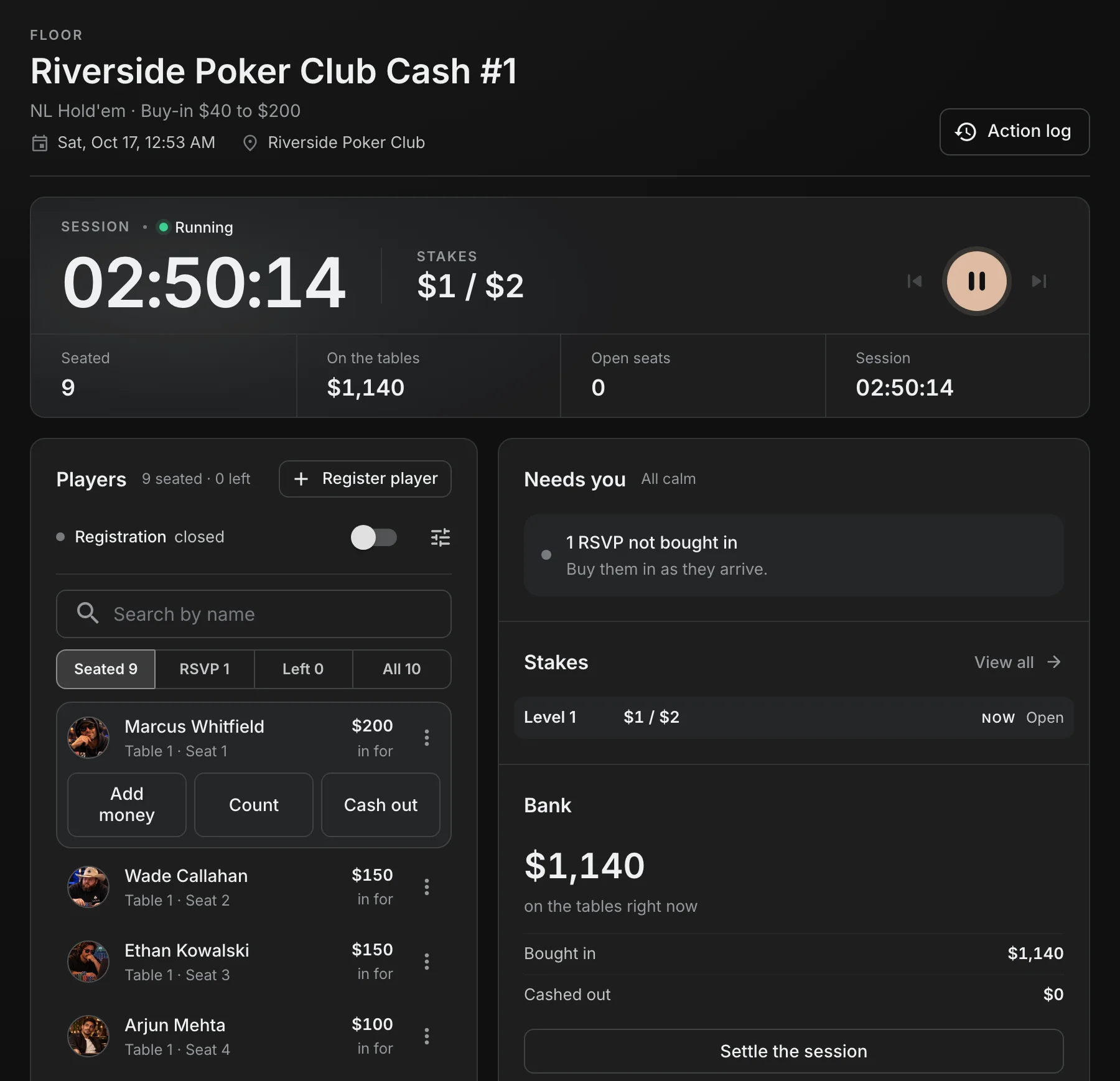
The clock shows the session time and the stakes, and its numbers are who is seated, the money on the tables and the open seats. Tap a player for Add money, Count or Cash out; someone who left gets Buy back in, and an RSVP gets Buy in. Needs you counts the RSVPs who have not bought in, warns you when the stakes go up in the next 15 minutes, and asks you to settle once everyone has cashed out. The Bank panel holds the money: on the tables, bought in, cashed out, rake if you take one, and Settle the session.
The cash action log is the session's ledger and its seat moves. A wrong buy-in is voided with a reason rather than deleted, so the money record stays whole, and seat moves undo the same way a tournament's do.
On a phone
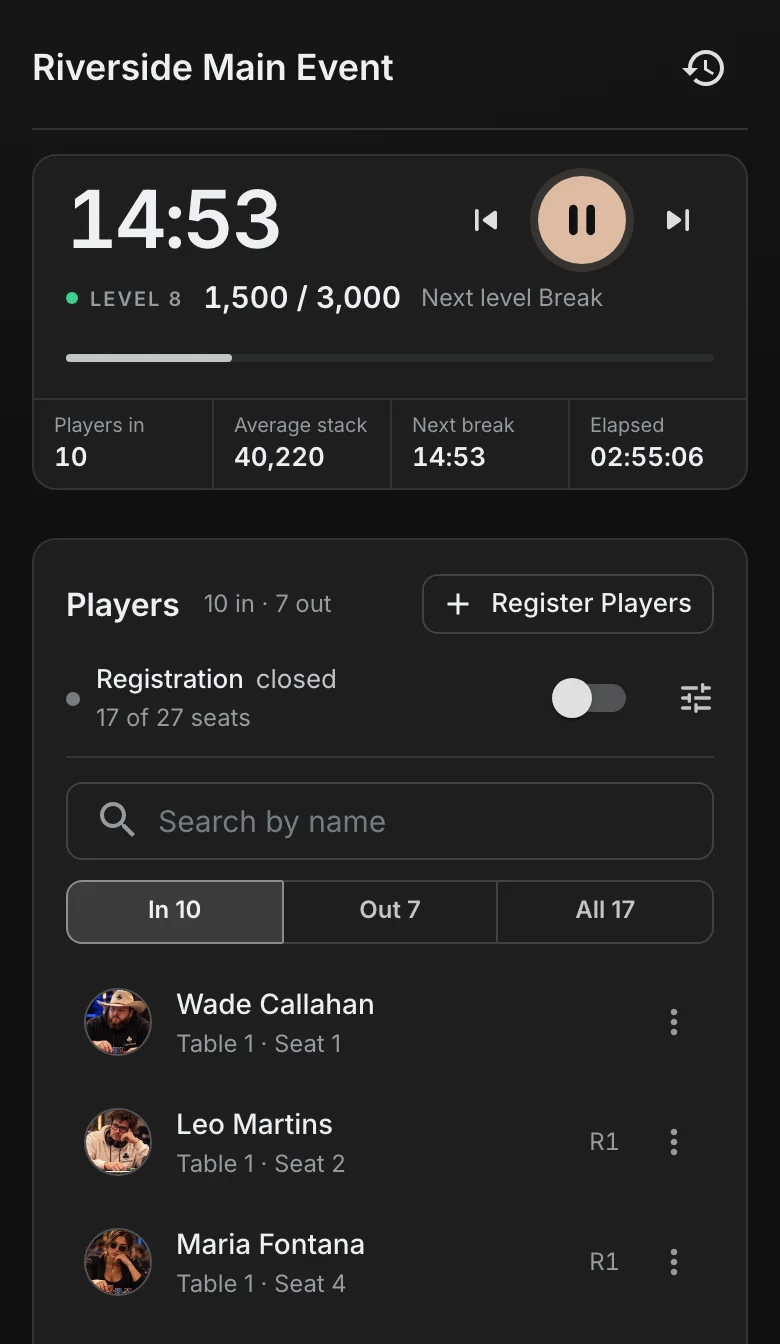
On a phone the Floor is in the game's bottom navigation, and it is the remote: the heading shrinks to one line, the clock becomes a compact card pinned at the top with its controls, and the roster comes straight after it.
What stays on the clock page
The clock page keeps its own controls. The clock widget's play, pause and level buttons are on by default, and a host can switch them off in the widget's settings for a clean display. The players widget's admin menu starts off, because the Floor is where the room is run from; turn it on in the widget's settings if you want it on the big screen. A club whose plan cannot save a lobby layout gets both switched on, since it has no way to change them.
The Floor is part of Premium, judged by the club owner's plan. On Free it shows the game's heading and its live clock, with the rest of the board locked.
Related Posts