 By Rafael CardosoNovember 20, 20266 min read
Shootout Tournaments: Every Table Plays to a Winner
A shootout is the format players ask for once they have played one. Every table is its own little tournament: you play down to one player, and only that player goes on. The winners meet at a final table. Nobody is moved, nobody is balanced, and the person who beat your table is the person you will face next. Running one by hand is the hard part: a sheet per table, a list of winners, a new tournament for the final, and a fight about who started with what.
Shootouts are now a format in The Club House. You create one in the tournament wizard, draw the tables from the Floor, play each table down, and end the round with one button. The app builds the next round from the table winners, draws it, and keeps every round, every table and every winner on a bracket.
Create a shootout in the wizard
Start a tournament the usual way and choose Shootout under Format. The next step is Rounds: how many players sit at each table, from heads-up to ten-handed, and a preview of the rounds a field of that size makes. Type the number of players you expect and the preview follows. It is only a preview. The rounds come from the players who are there when Round 1 is drawn.
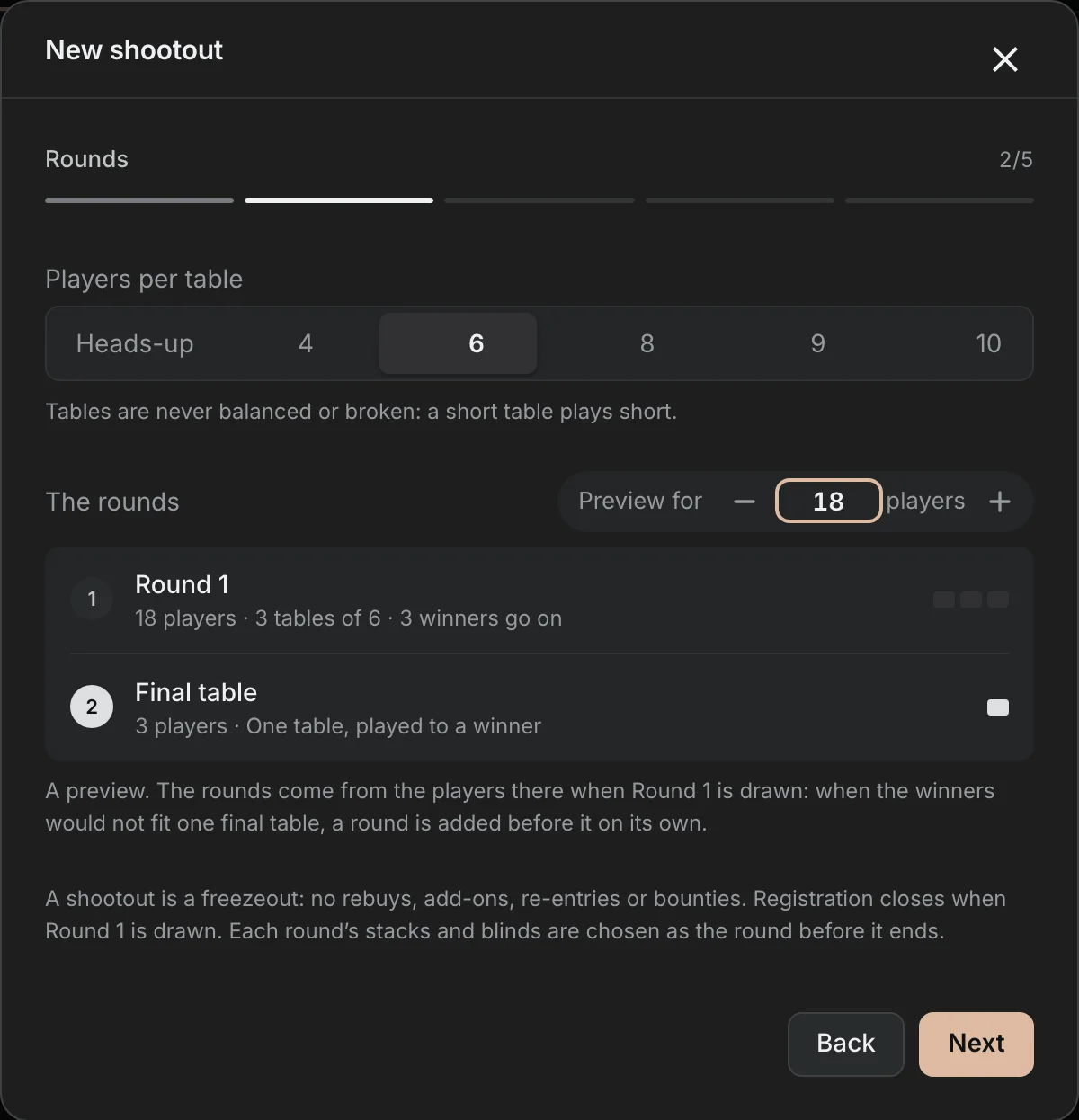
A few rules come with the format, and the wizard sets them for you:
- A freezeout. No rebuys, add-ons or re-entries, and no bounties: a winner who goes on would pay one out again in the next round.
- Tables are never balanced, broken or redrawn. A short table plays short.
- A final table seats up to ten. When more players win their tables than one final table can seat, a round is added before the final on its own. Heads-up, the final is a match of two.
- One prize pool. Every buy-in goes into it, and the final pays it out. Players out in an earlier round keep their place, by when they busted.
Draw the tables
Register the field as you would for any tournament. When everyone is there, the Floor shows what the draw builds for the players actually registered, and the rounds that field makes after it. Drawing seats everyone at random, as evenly as the tables allow, and closes registration.
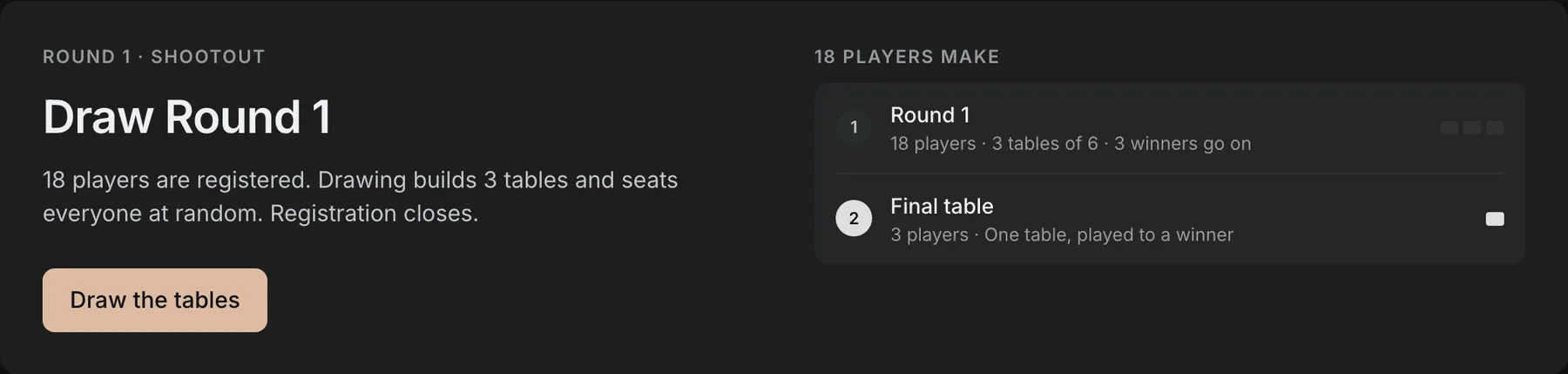
If your room checks players in, only the players who have checked in are drawn. Someone who walks in after the draw is checked in and seated at once: at a table still playing that has room, or, in a heads-up bracket, against a player who had a bye.
Play every table down
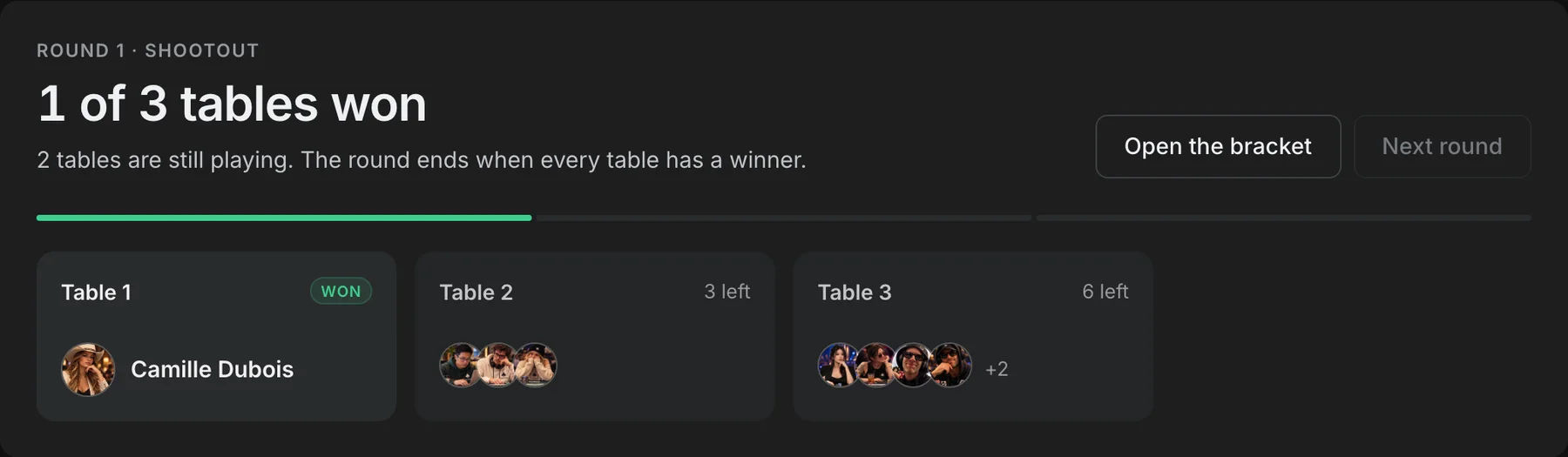
Each table plays like a tournament of its own. You eliminate players from the Floor as you always do, and who knocked them out is picked from their own table. The Floor counts the tables won and gives each table a tile: its winner once it has one, or the faces of the players still in.
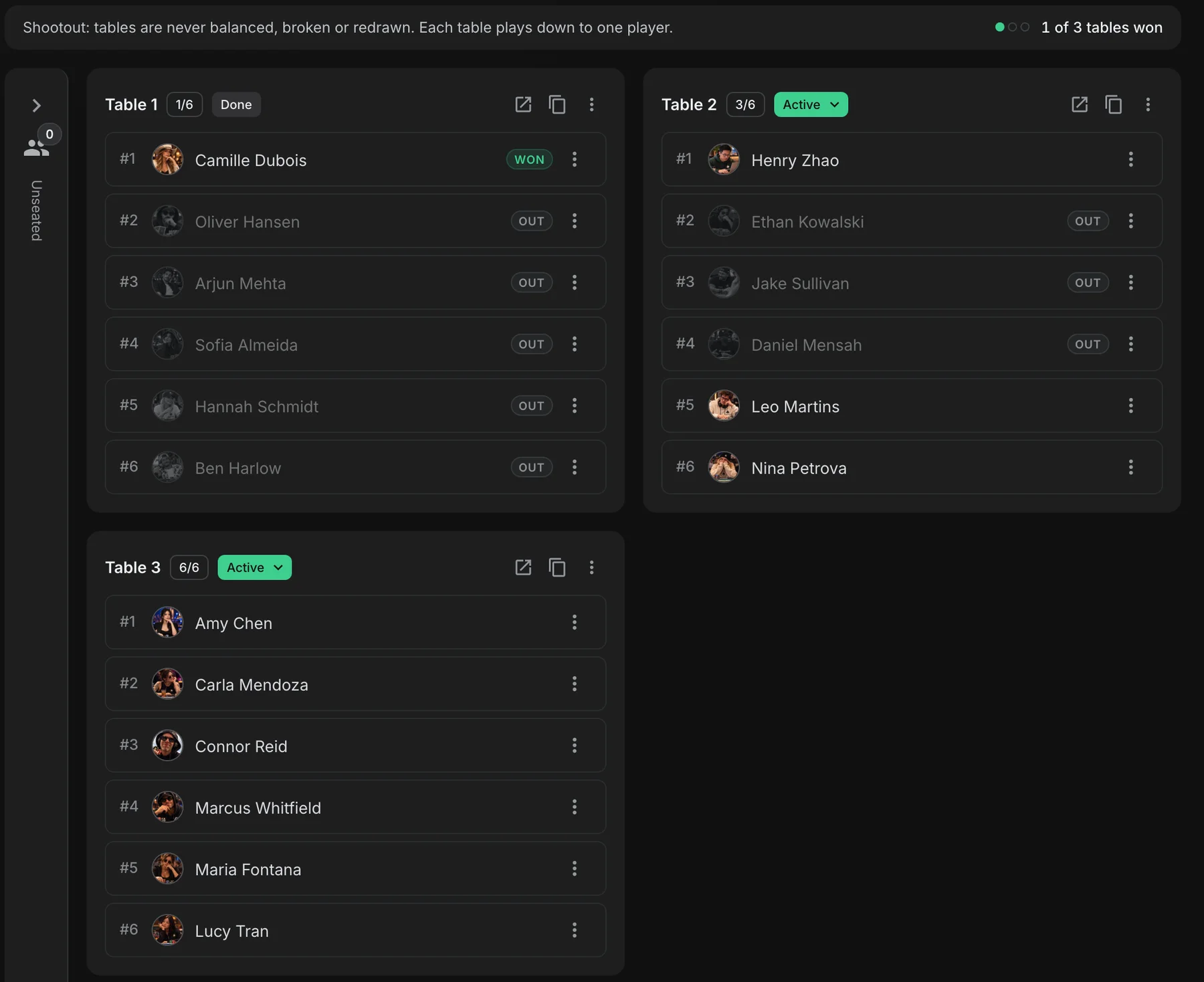
The Seating page shows the same round seat by seat. A table that has its winner reads Done, its winner reads Won, and everyone who busted stays where they sat, faded and marked Out, so you can see at a glance who was at each table and who is left. A heads-up bracket with an odd field gives some players a bye; their table reads Bye and they go through.
When a mistake happens
Rooms make mistakes, and a shootout makes some of them easier to make. The ones we tested hardest:
- A wrong elimination is undone from the Floor's Action log, and the player goes back to their own seat.
- The last player at a table cannot be eliminated: they have won it. The dialog says so, and tells you to undo the bust that was wrong instead.
- A wrong knocker is corrected in the player's editor, and a stack counted wrong is fixed with Adjust stack.
- A player can be moved to another table by hand. They count at the table they end the round at.
- Once a round has ended, who went out and who went on stands: a bust in it can no longer be undone, and the next round takes only that round's winners.
End the round
The moment the last table has its winner, End Round opens by itself. It lists every winner and lets you choose what they start the next round with: equal stacks, as the big series do at their shootout final tables, or the chips they won, every chip that started the round at their table. If a count at a table differs, type the right number on the winner's row; the change is marked and can be put back. You also choose whether the blinds carry on or go back to level 1.
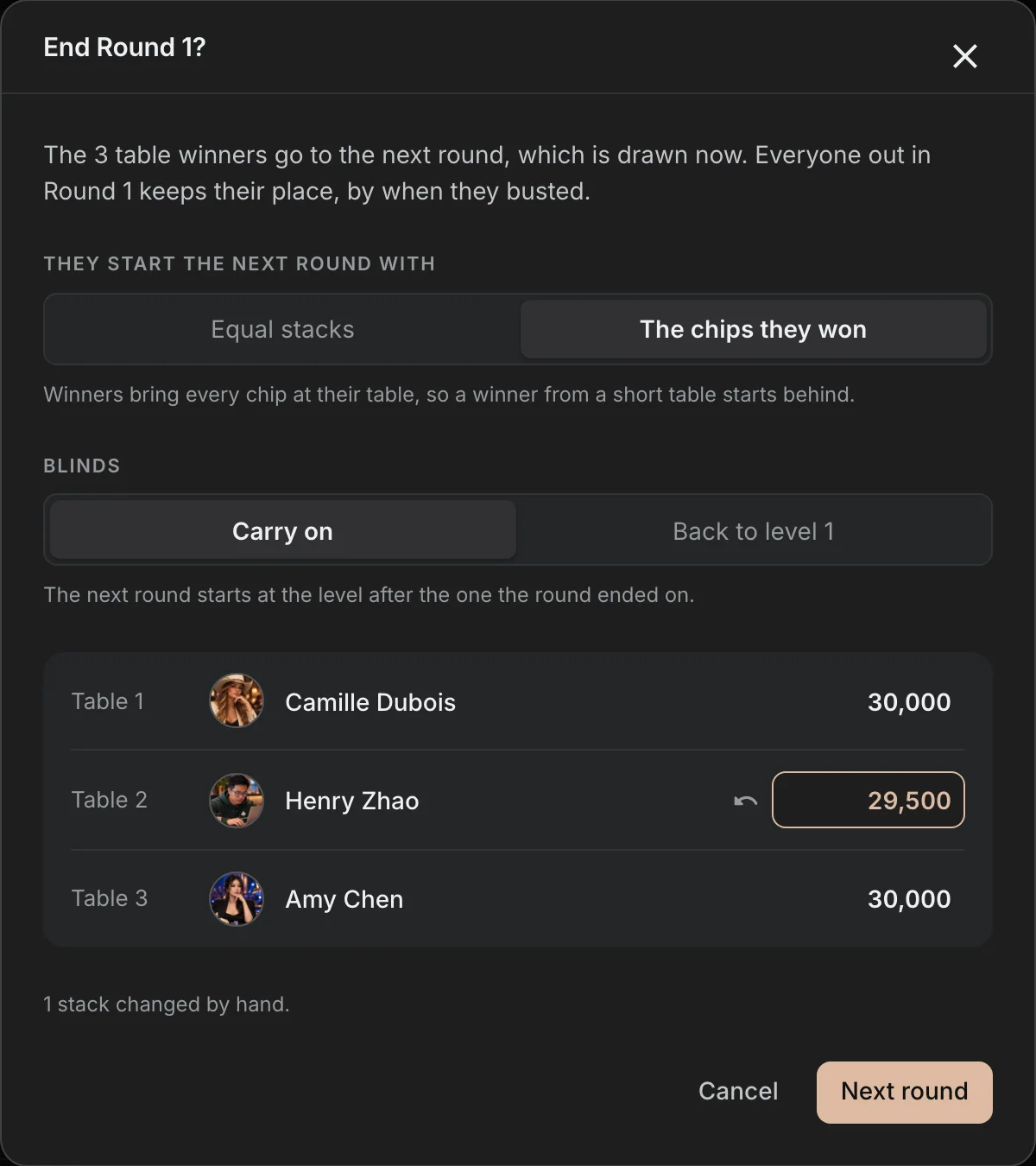
Next round ends Round 1, builds the next round from the winners with the stacks shown, draws its tables and takes you to its Floor. The final plays like any tournament, to a winner.
The bracket
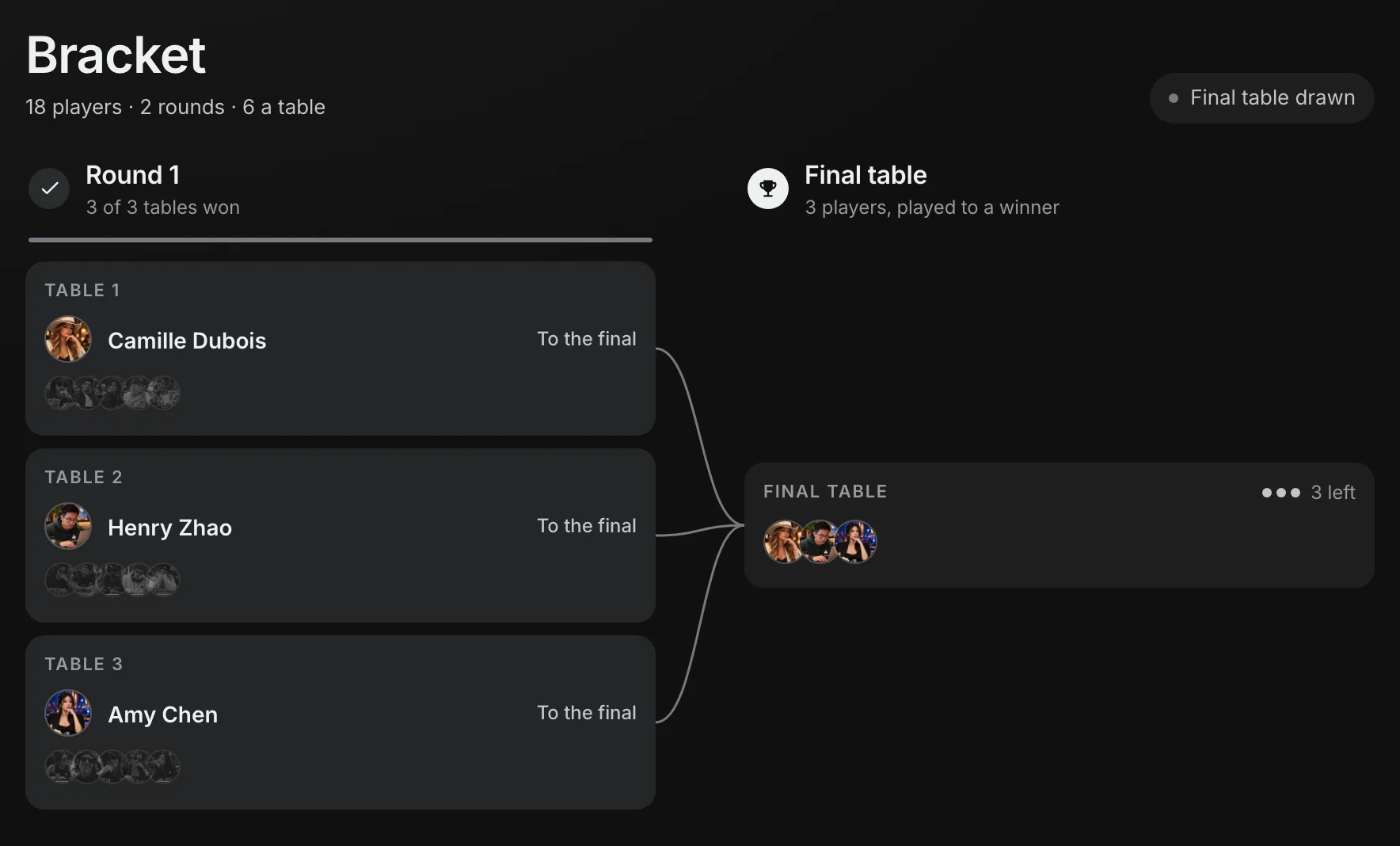
Every shootout has a bracket. Rounds are columns, each table a card with its winner and the players they beat, and a line from each table to the one its winner plays next. Rounds still to come are drawn too, so players can see the path to the final before it is played. In a heads-up shootout you choose how the winners meet. On a fixed bracket, as the big heads-up events play it, the winners of tables 1 and 2 meet at table 1, and so on, so everyone knows their path. With a random draw, the winners are drawn to new tables every round and nobody knows their next opponent until the draw. You set it when you create the shootout, and End round lets you change it for the next round.
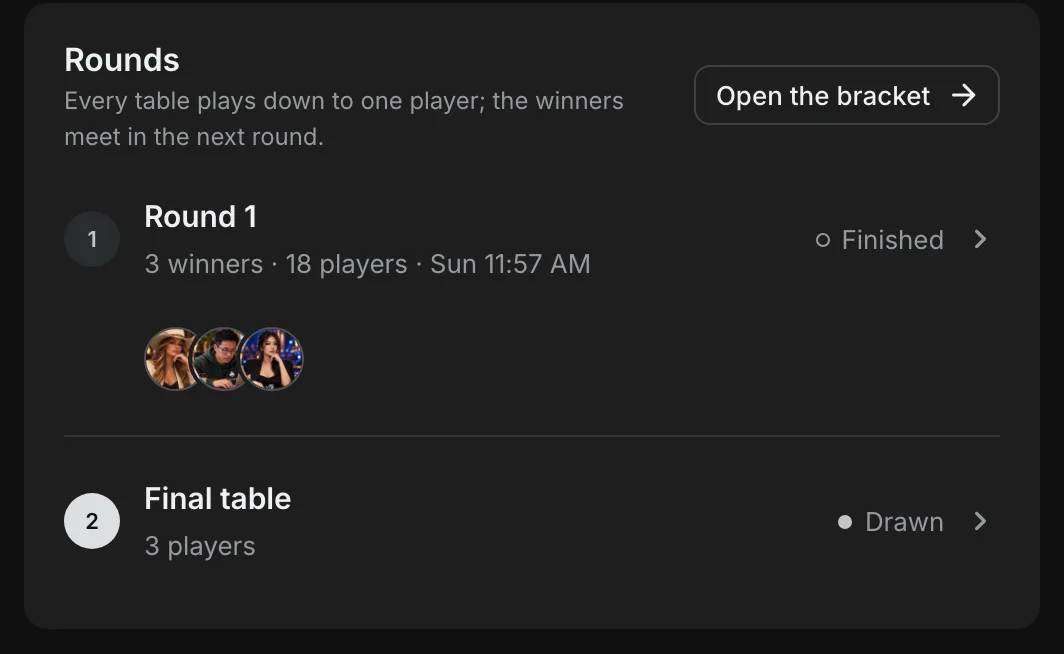
The event page keeps every round in order, with its winners and its state: finished, playing or drawn. Tap the faces of a round to see who went on from each table.
The room sees it too. The TV and the tournament lobby show a Table winners widget that ticks each table off as it is won, and players following on their phone see how many tables are won and how far they got.
Any table size
Heads-up brackets with byes, or four to ten a table. Rounds are added on their own when the winners outnumber a final table.
Stacks your way
Equal stacks or the chips they won, chosen as each round ends, with any count corrected by hand.
One prize pool
Every buy-in in one pool, paid on the final, with everyone placed by how far they got.
From your AI app
Connected through MCP, you can create a shootout or a multi-day event by asking for one.
Shootouts are part of Premium. A shootout already running keeps playing on any plan.
Related Posts